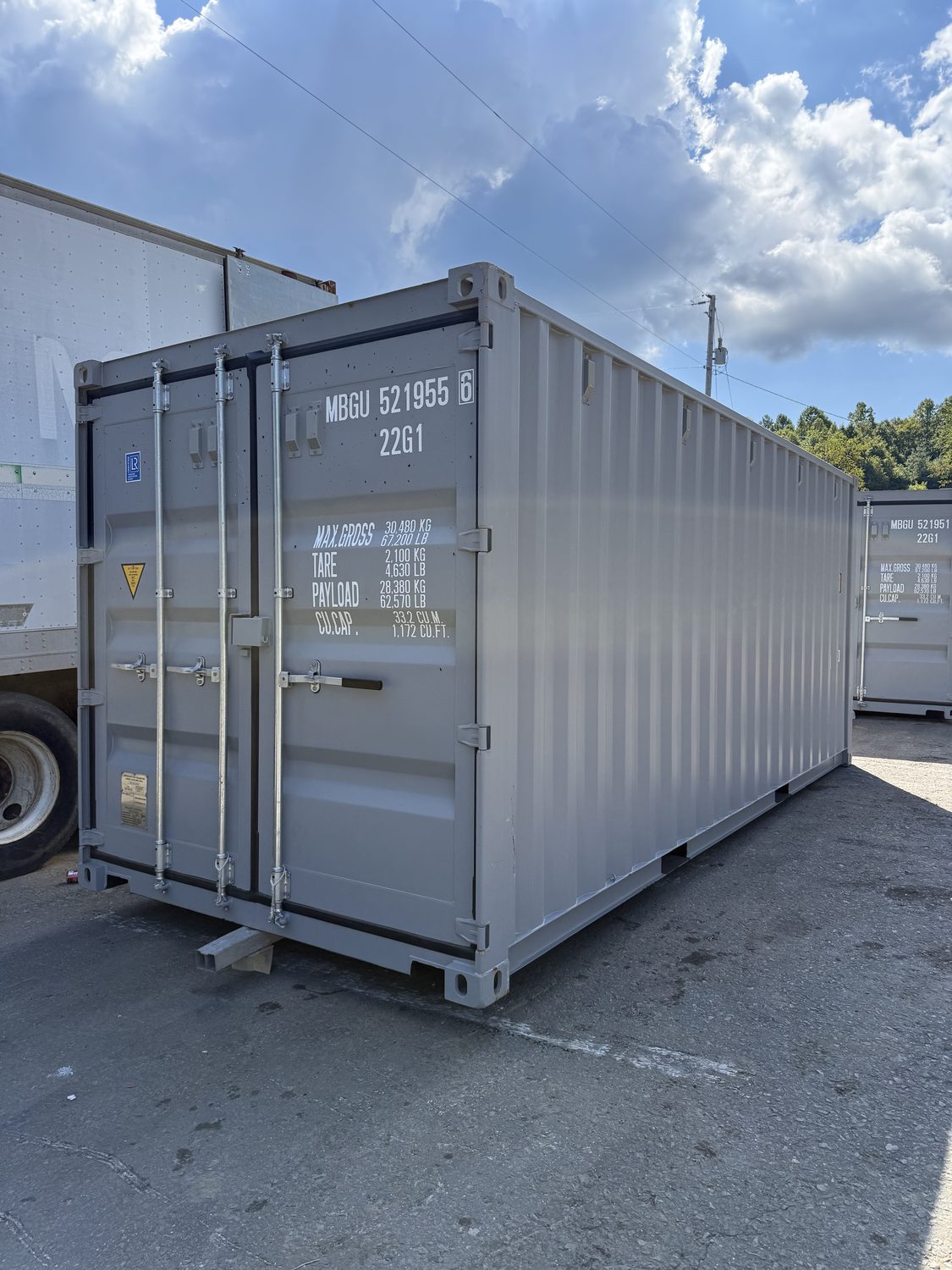
Every so often somebody calls us holding a number from somewhere else. An auction closed, or a marketplace listing looked right, and the figure at the top sat well under anything we would quote for the same size box. That number is usually honest. It just is not the whole number, and nobody selling a container off a screen is under any obligation to point that out before you click buy.
This page will not argue you out of buying that way, and it is not going to tell you anyone lied to you. It assumes the seller told the truth and asks a plainer question instead: once you accept that number, what else still has to get arranged before that container is sitting on your ground, level, secure, and actually usable. Price each of those pieces out yourself, in your own area, and add the total to the number you started with before you compare it to anything else.
The number you saw prices one thing: the container
Whether it came off an equipment auction, a government surplus auction, or a listing on a marketplace app, that number is attached to one thing only: a box, sitting wherever it happens to be right now. That might be a depot, a rail yard, or a stranger's side lot two states over. It is not attached to your road, your ground, or your address, because the person who set that number has never seen any of the three and was never asked to price them.
This is not a page about dishonest sellers, and it is not a page about what makes one container cost more than another. Plenty of auction and marketplace listings are exactly what they claim to be, sold by people telling the truth about the box. The fraud patterns have their own guide, our container scams and red flags page, and the handful of things that move a price up or down have theirs, what drives container prices. This page starts after an honest number is already decided and asks a narrower question: what still has to be added to it before it is a true total.
Getting it from there to here is its own job
Unless the listing says otherwise in plain words, that number gets the container to the edge of the seller's world, not to your driveway. Somebody still has to move it the rest of the way: off the lot it is sitting on, down whatever roads connect that spot to yours, and onto your ground in one piece. That is a specialized haul, a flatbed or tilt bed rig and a driver who does this for a living, and none of it becomes free just because a screen did not mention it.
Finding that truck is your job now, not the seller's. You end up calling around for a hauler who has never driven your road, describing turns, hills, and how far off the pavement your spot sits, over the phone, to somebody pricing a trip they have never seen. Whatever quote comes back is a second relationship, a second conversation, and a second bill, arranged only after you have already committed to the first one.
A transport quote is only worth trusting once it answers a short list of questions, in writing, before any truck leaves anywhere:
- The full distance it is actually driving, from wherever the container sits today to your exact address, not to the nearest town or a rough ZIP code.
- Whether the driver has actually been told about your road and your ground, and not just handed a pin dropped on a map.
- What happens, and who pays, if the truck cannot make the final turn onto your property and has to set the box down somewhere else.
None of that is a reason to walk away from an auction or a marketplace container. It is a reason to get that number sitting in your hand, in writing, before you decide anything, the same way you would price out any job that involves more than one contractor.
What you don't get a look at before you pay
A local yard lets you walk the row, pull a set of doors shut yourself, and look up at the roof before any money changes hands. Most auction listings, and a good share of marketplace ones, do not offer that, because the container usually is not the seller's to walk you to, or the sale closes before a viewing was ever realistically on the table. You end up deciding off a description and a handful of photos instead of the actual box.
Whatever condition word is attached to the listing is doing most of that description's work, and nothing requires two different sellers to mean the same thing by it. What that gap genuinely costs a buyer, in plain terms, is the whole subject of our guide to buying a container sight unseen, and it is worth reading before you commit to anything you cannot walk up to yourself.
A lot of these sales are written as-is, and that phrase is doing real work too. Once the container is yours, whatever turns out to be wrong with it is yours as well: a soft spot in the floor, a door seal gone hard and cracked, rust further along than the photo let on. There is usually nobody to call back about any of it, because the sale already said as much in writing before you paid.
If you do get a real chance to look at a specific unit before you commit to it, in person or over a video call, our inspection checklist is the short list of exactly what to check while you still have the chance.
What doesn't ride along on the truck
Say the truck shows up on schedule and the driver gets the box off cleanly. That solves one problem, not all of them. A lot of what makes a container actually livable the day it lands is not part of the container itself, and none of it is guaranteed just because a delivery happened on time.
- Leveling. Unless you asked for it by name and it was quoted as its own line, nobody blocks the container level on the way off the truck. A box sitting even slightly off level lets the doors bind and sends rainwater running the wrong way across the roof, and squaring that up after the fact is a project of its own.
- A lockbox. Auction and marketplace containers rarely arrive with the locking bars covered. If you want the doors genuinely secure once you own the thing, that is hardware you now have to go source and have welded on yourself, after delivery, instead of before the truck ever left the lot.
- Someone local to call. Every so often a box lands a little off from where it was supposed to sit, or the driver cannot quite reach the exact spot and sets it down as close as the ground allows. With a real yard behind the sale, you call the same number you called to order it in the first place. Buying through a platform, there is often no local business on the other end of that call at all, which is most of what separates a yard from a broker to begin with.
Add it up before you compare totals
None of the pieces above came with a number attached, and that is on purpose. We do not know your route, your ground, or the seller you are dealing with well enough to guess at any of them, and a guessed figure would be worse than none at all sitting on a page like this. What we can hand you instead is exactly what to go get a real number for before you set an auction or marketplace total next to anything else.
| What the listing shows | What it usually leaves out | Who ends up handling it |
|---|---|---|
| A number for the container | The haul from where it sits to your address | You, calling around for a truck |
| A grade or condition word | A look at the actual box before you pay | You, trusting the description |
| As-is in the fine print | Any recourse if the floor or seals are bad | You, once the truck has left |
| A delivery date | The box actually set level on your ground | You, or whoever you call next |
| A container, nothing more | A lockbox or other real security | You, sourcing it after the fact |
| A drop-off | Someone local to call if it lands wrong | You, with no number that picks up |
None of this is a knock on auctions or marketplaces. It is the list to price out before a headline number gets compared to a delivered one.
Call your own hauler and get the mileage priced from where the container sits today to your actual address. Call whoever you would trust to weld on a lockbox if you end up supplying your own container. Decide, honestly, what an inspection or a video walkaround before you pay is worth to you. Add all three answers to the number you started with, and only then set the total next to a delivered price.
Or skip the arithmetic and let us run it for you. Tell us the size and where it needs to go, and we will quote the whole job, truck, leveling, and lockbox folded into the one number, the same day you call. Reach us at (276) 237-6144, or see how we build that number in the first place on the cost page.