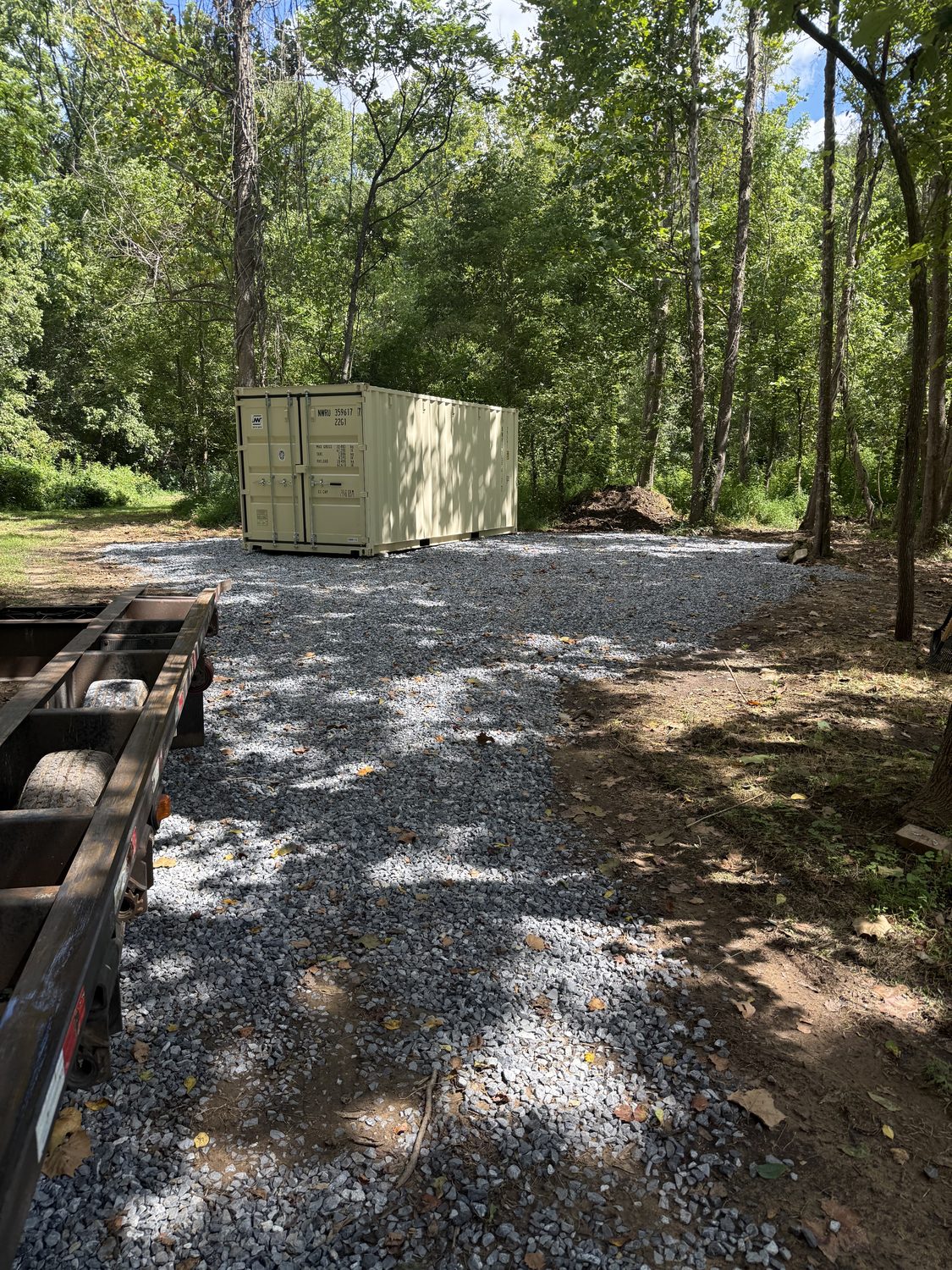
Floyd County is the clearest example on this site of why we write these permit pages one locality at a time. Ask whether you can set a storage container on a piece of Floyd land and there are two honest answers, and which one is yours turns on a boundary that does not show up in your mailing address.
The short version. Floyd County publishes no zoning ordinance. Its Code of Ordinances page lists five adopted ordinances and plans and zoning is not among them. The Town of Floyd, the county seat sitting inside that same county, has an adopted zoning ordinance with a section titled Storage Containers, and that section caps a container accessory to a detached single family lot at 16 feet in length, allows it 14 days at a time and no more than twice a year, and requires a zoning permit first.
That is a container specific ordinance, written for exactly the thing we deliver, and it changes what we can honestly sell you inside the town limits. This page walks the county side, the town side, the state building code that applies on both, and who to call before the truck is loaded.
One county, two answers, and a line you cannot see from the road
The Town of Floyd is separately incorporated, with its own Town Council, Planning Commission, zoning ordinance and zoning map. The county draws that boundary itself: the Floyd County Land Division Ordinance defines its scope as land within Floyd County excluding the incorporated boundaries of the Town of Floyd, and it names no other town, because there is no other.
So the first thing to settle is not what an ordinance says about containers. It is which government you are standing in, and address labels are no help: plenty of property carrying a Floyd address sits outside the corporate limits. The town office at (540) 745-2565 settles it in one call, and that call belongs before you pick a size.
What Floyd County publishes, and what it does not
The county's Code of Ordinances page lists what Floyd County has adopted: a Comprehensive Plan, a Manufactured Home Park Ordinance, a Solid Waste Ordinance, an Ordinance Prohibiting Pre-1976 Manufactured Homes, and a Land Division Ordinance. No zoning ordinance appears on it. The Building Inspections page numbers what that office enforces, the Uniform Statewide Building Code and the codes referenced within it plus the Erosion Control, Manufactured Home and Subdivision ordinances, and no zoning appears there either.
The Land Division Ordinance, adopted November 18, 2025 and effective January 1, 2026, never uses the word zoning and never uses the word container. The Manufactured Home Park Ordinance goes further, grounding its authority in Va. Code 15.2-2247 and quoting it: a locality may designate where manufactured homes may be located notwithstanding the absence of a zoning ordinance in such locality. That is the statute a Virginia locality reaches for precisely because it has none.
No county document we read says in words that Floyd County has no zoning ordinance, so the finding rests on consistent absence across every county source plus that citation. What we publish is that the county publishes no zoning ordinance, no zoning map and no zoning administrator, and therefore no container provision. That does not make county land unregulated: deed restrictions, covenants and easements sit on a parcel whether or not a county zones, and we walk that layer on the Carroll County page.
The Town of Floyd wrote a container rule, and it is specific
The town's code index runs chapters 1 through 21 and then Appendix A, the Zoning Ordinance, with a separate Zoning Map beside it. Article 3 defines a Storage Container as a portable, weather resistant receptacle used for the temporary storage or shipment of items, excluding dumpsters and refuse containers. That is our product, named, and Article 11, Section 11.4 is what governs it.
| What it governs | What the ordinance says |
|---|---|
| Permission | "The temporary placement of any container on any lot shall be permitted only upon issuance of a zoning permit, except for a container in an industrial zoning district" |
| Purpose | "Containers shall be permitted only for temporary storage for the lot on which the container is located" |
| How long | "A single container shall be permitted per lot for a maximum 14-day period, and for no more than two times per year" |
| How big | "A container may not exceed 16 feet in length, eight feet in width and eight and one-half feet in height when accessory to detached single family use (unless agricultural in use)" |
| Where on the lot | Behind the front building line, only in an approved paved area, meeting all district yard setbacks and prohibited in buffer areas |
| Principal structure | "Containers are prohibited on any lot without a principle structure" |
| Stacking | "Vertical stacking of containers is prohibited" |
| Utilities | "Containers shall not be connected to utilities" |
| General storage | "Storage Containers are not to be used as a general storage (e.g. a shed)" |
Left column headings are ours; quoted text is the ordinance's own, spelling included. The 14 day and twice a year limits apply to agricultural, detached single family, attached single family and two-family uses. The 16 foot length cap applies only to a container accessory to detached single family use, and not where that use is agricultural.
Industrial lots get a separate allowance of up to three containers at once, each for 14 days, with longer stays requiring a screened storage yard behind the front building line and a conditional use approval. A disaster recovery allowance is tied to a building permit for repair of the principal structure, and containers on an approved construction project sit outside Section 11.4 entirely.
We are not dating this ordinance. The town posts the file under a 2024 path, its footers read 2020, and its effective date clause says only that it takes effect upon adoption. So we call it the town's currently posted zoning ordinance, sitting on the town's website as Appendix A of the town code, and you should read it there rather than treat our summary as the last word.
The sentence that costs us a sale inside town limits
Our stock is 20-ft and 40-ft. The town's cap for a container accessory to detached single family use is 16 feet in length, shorter than the smallest box we sell. Then add the rest of Section 11.4: 14 days at a time, twice a year at most, a zoning permit each time, a paved area behind the front building line, nothing on a lot without a principal structure, and no utility connections.
Read together, a permanent 20-ft or 40-ft storage container on a residential lot inside Floyd town limits is not what the town ordinance permits. We would rather write that than sell you a box and let a zoning notice deliver the news. If you are inside the limits and want steel that stays, call the town, ask for the Zoning Administrator by title since the name is not published, and ask what Section 11.4 leaves open. Outside the corporate limits, which is most of this county, none of it touches you.
The building code is the county's job on both sides of the line
The building code half of this is settled statewide, and it is the half that does not change at the town line. 13VAC5-63-20, Section 102.3 Exemptions, item 11 covers intermodal freight, moving and storage containers placed on site temporarily or permanently for use as a storage container, and 13VAC5-91-20 exempts the same container from the Industrialized Building Safety Regulations when it is used for storage. What the exemption turns on is what the box is being used for, and it carries no expiry date.
Floyd County administers that code through Building Inspections at 202 E Main St, enforcing the 2021 Uniform Statewide Building Code and the I-codes referenced within it. Its permit menu covers building permit packages, decks, demolition, electrical, erosion and sediment, farm, garage or carport, generator, inflatable, plumbing and mechanical, and sign. No storage building permit, no accessory structure permit, no container permit.
Inside the town the building code is still county work: the town's contact page lists the county Building Official, and the town ordinance defines Building Code as the Uniform Statewide Building Code as adopted by Floyd County. Within the corporate limits your zoning call goes to the town and your building code call goes to the county.
Where the exemption ends is the line we publish statewide. Convert the box into space people occupy and you are into Section 3115 of the Virginia Construction Code and a real permit. Two county details if you get there: work must begin within six months of permit issuance or the permit becomes invalid, and inspections are scheduled at (540) 745-9359 with 24 hours notice. Our own side does not vary by county. Electrical is roughed in only, a licensed electrician does the final hookup and the inspection, and we do not pull permits. The state level reading is on our Virginia container permit guide.
Two things the county publishes that are worth reading back to them
The setbacks the county publishes
In the Building Inspections page's own words: 35 feet from the edge of roadways, state maintained and private, 60 feet from the center of the road, and 5 feet from structures and property lines, residential only. The page states them flatly with no citation, and none of the county ordinances we retrieved contain them.
We are not going to tell you those distances legally bind a container the state code exempts, because the county page does not say so and we do not know. Read the line back to the building official and ask whether they attach to an exempt storage structure or only to permitted construction.
Floodplain
The county lists no standalone floodplain ordinance among the ordinances it publishes. What it publishes is a route: contact the building official for permit regulations if you are building in the 100 year floodplain area, and expect to employ a surveyor for an elevation certificate showing the floor one foot above flood elevation. FEMA's Community Status Book lists Floyd County as a participating community in the National Flood Insurance Program, with no separate entry for the town.
So that gate runs through the Building Official rather than a zoning office. We could not verify the text of any county floodplain ordinance, so we will not claim a container is or is not regulated in the Floyd County floodplain. If your spot is near the Little River or a creek feeding it, call (540) 745-9358 first.
Three offices, and they are not interchangeable
Two county offices at one county address, and one separate government.
Floyd County Building Inspections
The building code office: the exemption question, the setbacks on their own page, floodplain, and any conversion into occupied space. Mark Bolt is the Building Official, Patrick Turner the Building Inspector.
- 202 E Main St, Floyd, VA 24091
- (540) 745-9358 for the department
- (540) 745-9359 to schedule an inspection, 24 hours notice required
- Open 8:00 a.m. to 4:30 p.m., Monday through Friday, and permits are not issued after 4:00 p.m.
Floyd County Community and Economic Development
Listed on the county site as Planning and Economic Development. Lydeana Martin is the Director and Karla Turman the Planner, who also staffs the Planning Commission. This is the desk for land division and the Comprehensive Plan.
- 202 E Main St, Floyd, VA 24091
- (540) 745-9300
- Open 8:00 a.m. to 4:30 p.m., Monday through Friday
Town of Floyd, a separate government
The zoning office for any address inside the corporate limits, and the only office that can confirm whether yours is one. Andrew Morris is the Town Manager and Lynn Gregory the Clerk and Treasurer. Ask for the Zoning Administrator by title.
- 203 East Oxford Street, Floyd, VA 24091, mailing address P.O. Box 27, Floyd, VA 24091
- (540) 745-2565
- Open 8:30 a.m. to 4:30 p.m., Monday through Friday
The county Planning Commission meets at 6:00 p.m. on the third Tuesday of each month at 202 West Main Street, second floor.
Five questions, then the size and the budget
- Is my address inside the Town of Floyd limits or in unincorporated Floyd County? Ask the town at (540) 745-2565.
- Inside the limits, is there any path to keeping a 20-ft or a 40-ft container here? Ask the Zoning Administrator about the conditional use path in Section 11.4.
- On county land, does anything apply to a storage container I am not converting? Ask Building Inspections at (540) 745-9358 and name 13VAC5-63-20, Section 102.3, item 11.
- Do the setbacks published on your Building Inspections page apply to a container I am not permitting?
- Is this parcel in the 100 year floodplain, and what changes if I later add a man door, insulation or wiring?
Log the name of whoever answered and the day of the call.
With the jurisdiction question settled, what remains is sizing and budget. Delivered, a used cargo-worthy 20-ft is $3,200 and a 40-ft is around $4,900. A 20-ft rents at $165 a month if buying is not where you want to land. The welded lockbox is already on the box when it leaves the yard, and delivery and leveling are free within 75 road miles of Woodlawn, which covers Floyd County comfortably.
Weighing the two, our buy versus rent guide shows where the cost lines cross. Once the paperwork is settled and the question is the ground, read delivery preparation and the foundation guide.