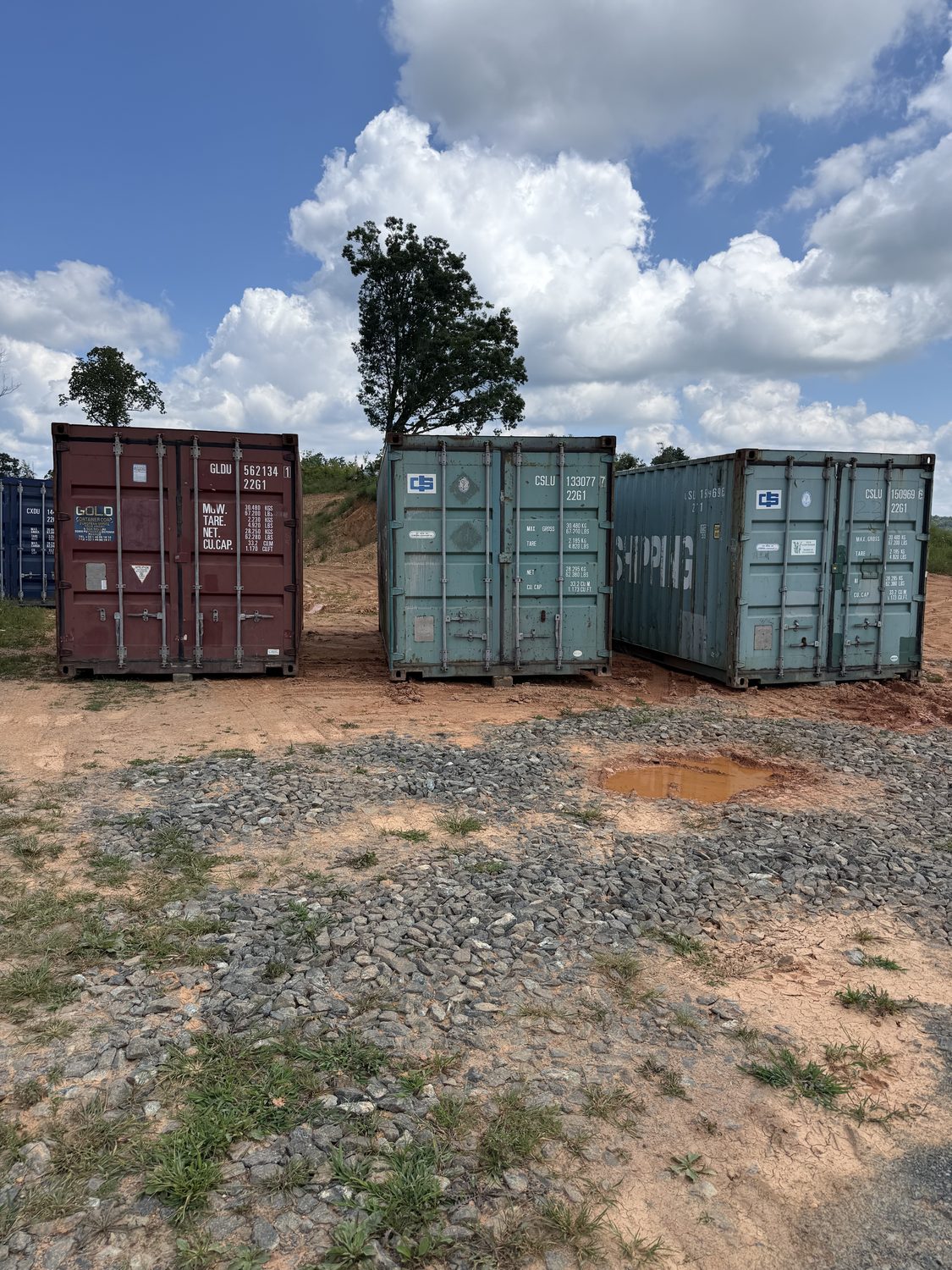
A container yard is not a showroom. It's a few acres of gravel, a row of steel boxes in different states of used, a truck, and a running list of small jobs that have to get finished before any of that steel is fit to sell to anybody.
Most people never see that part. You call, a container shows up, and from where you're standing that's the whole transaction. This page is the other side of it: what happens to a container between the day it rolls into the yard on Elk Horn Road and the day it sits level on your gravel with the doors swinging true. None of it is glamorous. All of it is the reason a box out of a real yard behaves differently from one bought off a website that has never touched it.
Buying the steel and hauling it in.
Nothing in southwest Virginia manufactures shipping containers. Every box sitting on the ground here started its life somewhere else, moved through the port and rail system, and got trucked inland to a yard like ours. That first step is a buying decision made on somebody's judgment: what condition is available, what's moving, and what a customer around here is actually going to want once it lands.
Then it has to physically get here, and that's a haul. A container isn't freight you slide onto a pallet with three other things. Each one is its own load on its own trailer, and somebody drives it in over the same mountain roads you drive. The trip is done and paid for before the unit is worth a thing to anybody. That's the quiet part that separates a yard from a listing site: we're into a container the moment it lands, whether it sells this month or sits until spring.
It also explains why a real yard's selection is narrower than a website's. A site can advertise every size and condition ever built, because it isn't holding any of them. We can only show you what somebody was willing to buy and haul. If you want the longer version of how these boxes get out of the shipping system and into a field out here, that's covered in where used containers come from.
Putting it down somewhere that holds.
A loaded truck coming through the gate needs somewhere to set the box down, and that somewhere has to hold. Steel this size puts a lot of weight on four corners. Set one on ground that's soft and it doesn't stay where you set it. The corners sink, the frame twists a little, and now the unit you were planning to sell has a problem it didn't arrive with.
So yard ground is a maintenance job of its own. Gravel gets added where the lanes rut out. Water gets pushed away from the rows instead of running through them. After a wet stretch the low spots get left alone until they dry, because a truck stuck in your own yard is most of a day gone. It's the same lesson your own site will teach you later, on a smaller scale.
Staging matters as much as the ground does. Units get set in rows with enough space between them to walk the sides, swing a door all the way open, and get a light inside. A yard packed wall to wall looks efficient and can't show you anything. If nobody can open the doors on a container, nobody can inspect it, and that includes us.
Looking hard at what showed up.
Every unit gets opened when it lands. Doors first, because door gear tells you how the container was treated: handles that still move, or handles somebody has been beating on with a hammer for years.
Then the inside, and the old trick still beats anything else. Get in, pull the doors shut behind you, and stand there while your eyes adjust. Pinholes show up as stars. Roof seams and the top of the side walls are usually where they are. From in there you can also see where a previous repair was made, where water has been running down a wall, and whether the floor gives anywhere underfoot.
Outside, it's the roof, the sills and the frame. Standing water up top means a low spot or a dent holding it, and that spot is where the next hole starts. Rust along the bottom rail is normal on a used box and matters more than rust on a wall panel, because that steel sits closest to wet ground for the rest of the container's life. A bent corner post or a door frame out of square is a different conversation entirely, because that's structure, not surface.
Grading falls out of all that. Terms like cargo worthy and wind and water tight get thrown around loosely across this business, which is exactly why we'd rather you look at the box than the label on it. Units that aren't going to go out as watertight come off the sale line. They get fixed, or they don't get sold as something they aren't. What the grades mean, and where they get stretched, is written out in container grades explained.
The repair list nobody photographs.
Most of what a yard does to a used container is small, dull, and worth more than it looks. A typical week is some mix of this:
- Freeing cam rods that have seized, then greasing the gear so the handles actually turn.
- Replacing door gaskets that have gone flat or torn, so the seal comes back.
- Welding pinholes and small patches before they open into holes you can see daylight through.
- Knocking back surface rust and treating it, along roof seams and bottom rails especially, before it eats all the way through.
- Patching or replacing plywood where the floor has gone soft from a leak upstream of it.
- Straightening door hardware and hinge pins that got clipped by a forklift in some previous life.
Rust is the one people read wrong. Surface rust on a used container isn't a defect, it's a used container. Steel that spent years crossing an ocean is going to have some. The question is whether anybody stopped it, or whether it got left alone long enough to work its way through the panel. A wire wheel and a can of paint on a Tuesday is the difference between a box that keeps going and a box that starts leaking on you.
Door gear is the other one. A container that's been sitting closed a long stretch will fight you the first few times you open it. That's usually dry hardware and a flattened gasket, not a broken door, and it's an easy job in a yard with the tools right there. It's a permanent annoyance once the box is in your driveway.
Bigger changes are a different line of work: cutting in a man door, adding vents, running electric, painting a unit to match a building. That isn't repair, that's a build, and it lives over on custom modifications.
The hardest problem is parking.
Here's the part nobody expects. The hardest logistics problem in a container yard isn't buying and it isn't fixing. It's making sure the specific box somebody wants can actually be pulled out of the row when they want it.
Containers arrive in one order and sell in a completely different one. A yard fills back to front, and steel doesn't move sideways. If the unit a customer picked is third in a row with two boxes parked in front of it, somebody spends part of a morning shuffling before the truck can even load. Stack them to save ground and you've traded a shuffle for a lift.
So placement gets thought about constantly. Likely sellers stay near the lane. Doors face the direction where there's room to swing them. Rows keep enough width for a truck to get alongside instead of nosing in and backing out blind. It's parking, honestly, with rust and heavier equipment.
It's also why we don't publish an inventory count. What's on the ground changes, and a number posted on a page goes stale by the middle of the week. Call and we'll tell you what's actually out there right now, or come see it: the yard is at 5567 Elk Horn Rd in Woodlawn, and walking the rows beats reading a spec sheet. What we've got moving on the sale side is on container sales.
Loading out and setting it level.
Nothing about a delivery starts on delivery day. It starts with a conversation about your spot, and that conversation is the highest value few minutes in this whole business.
What the driver needs to know is plain: what the ground is, gravel or grass or dirt or mud; how the truck gets in from the road; whether there's a gate and how wide it is; what's overhead, wires and limbs both; and whether there's straight room ahead of where you want the box to end up. Most units go out on a tilt bed, which means the trailer tips up and the container slides off the back as the truck eases forward. Plan on roughly 65 feet of straight clearance for a 20-ft container and about 95 feet for a 40-ft, plus room to back in before any of that starts.
Loading out is the yard in reverse. The right truck matched to the site, the unit brought up to the lane, doors worked one more time before it leaves so nobody discovers a seized handle standing in your driveway.
Then it gets set, and it gets set level. People assume this part is cosmetic. It isn't. A shipping container carries its strength in its frame and its four corner castings, and it stays square because all four of them are supported. Let one corner drop an inch into soft dirt and the whole box racks slightly. The door frame goes out of square right along with it. Now the doors bind, or they shut but won't lock, or they lock but won't open on a cold morning.
That is far and away the most common complaint people have with a badly set container, and it's entirely preventable: blocks under the corners, a level, and a few minutes of fussing before the truck pulls away. The ground under those blocks is your half of it, and that's laid out step by step in delivery preparation.
What a yard can't do for you.
An honest list, because knowing it up front prevents most of the bad days:
- We can't make soft ground firm. A loaded truck on saturated ground sinks, and then you've got two problems instead of one.
- We can't put a 40-ft container into a space with no room to back in. That isn't scheduling or attitude, it's geometry.
- We can't promise a specific unit will still be here next month. Somebody else can buy it before you do, and we're not going to pretend otherwise.
- We can't tell you what your county's zoning office will say. That varies across Virginia, West Virginia and North Carolina, and the only answer that counts comes from them.
Every one of those gets easier if we talk before the truck is loaded instead of after. A short phone call about your driveway, your gate and your ground catches nearly everything a form won't, because we'll ask you things you'd never think to type into a box.
So call. (276) 237-6144, Monday to Friday, 8 to 5. Tell us where the container is going and what the approach looks like, and we'll tell you straight whether it works, what size fits, and what we can put together for you. If it won't work the way you're describing it, we'd rather say that on the phone than find out with a truck sitting in your yard.