It is ten past five, the light is going, and two guys are walking compressors and saws back out to the trailer, because nothing gets left on an open site overnight. Next morning they walk it all back in. Nobody bills for that. Everybody pays for it.
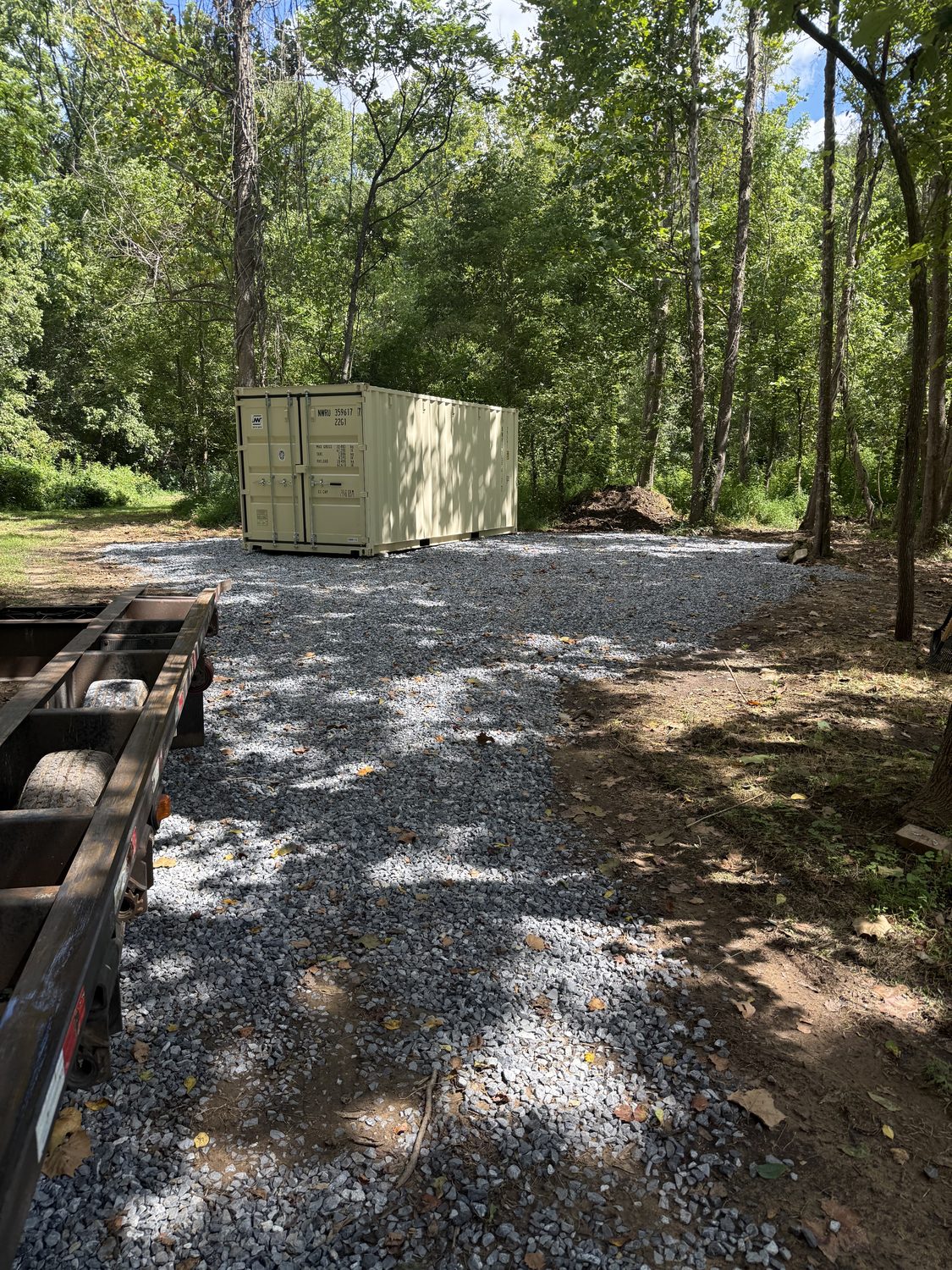
A container on the pad ends it. Same steel boxes we sell, set level on your ground, welded lockbox over the padlock. Here is how that runs on a live site.
Half of it is the lock. The other half is the loading.
Ask a foreman what a jobsite box is for and he says security. That is half of it. The rest is loading and unloading, which nobody schedules and everybody funds out of the job. The trailer gets loaded at the shop, towed, unloaded on site, then at quitting time it all runs in reverse, every working day, for the length of the build.
With a box on the pad the crew shows up and works. Saws, ladders, layout gear, fasteners, the fixtures nobody wants out in the weather: it lives there, dry.
The security half needs no explaining to a builder. Open sites get walked at night, and a missing tool costs more than the tool. It costs the morning, and a trade standing idle.
Locking it down on an open site
The container is not the weak point. Corrugated steel every side, a steel roof, cargo doors that lock from one point you control. The weak point is whatever hangs on the door.
Every box we deliver, rented or sold, goes out with a welded lockbox: a steel shroud over the padlock position, open just far enough for your hand and the key. Bolt cutters find no shackle to grab, and a grinder finds nowhere to put a wheel.
Then put a lock in it worth the box.
- Shrouded shackle padlocks. The body rises around the shackle so barely a sliver shows, and inside a lockbox even that is out of reach. An open shackle gives a thief something to grab.
- Puck locks. Round and flat, no shackle at all. The bolt sits inside the body, nothing standing proud to cut.
- Weight. Whichever style, buy the heavy hardened one. A bargain bin padlock inside a welded lockbox is a good lockbox wasted.
Two habits finish it. Face the doors in toward where the crew works and away from the road, so anybody at them stands out in the open. And keep the key list short: the super, the truck, one off site.
Set it once, in a spot it will not have to leave
The mistake that costs real money is not a security one. The box lands in the handiest open spot on day one, which turns out to be where the driveway goes, or where the excavator swings in month three. Moving it means another truck for a box already on your site.
So place it against the build sequence, not against what the site looks like this morning. Walk the plan first:
- What is still going in the ground, and where do those trucks and machines have to stand to do it?
- Where do the driveway, the pads and the septic field end up? Anything getting poured or graded is a no.
- Is the spot reachable in February as well as July? Ground you cross only when dry is not a spot.
- Do the doors have swing room, and can a truck back up square to them?
On a bigger site, two boxes beat one big one: a tool box and a material box. The tool box gets opened twenty times a day; the material box only when a pallet lands. Split them and the small expensive things are not behind a door that stands open all afternoon. A mobile office rides out on the same trip, and a crew that expects to keep one past this job can read up on buying a mobile office instead.
Delivering onto ground that is still rough
We deliver on a tilt bed. The bed comes up at the front, the back of the container touches down, and the truck eases forward while the box slides off behind. Nothing gets lifted, and that sets every rule about room.
Plan on roughly 65 feet of straight clearance for a 20-ft container and about 95 feet for a 40-ft, measured from where the box finishes up, plus room behind that to back in. Early in a build that is easy. In month four, with stockpiles and a dumpster in the way, it is not.
Ground is the other half. A loaded truck is heavy and has to keep moving in a straight line to do the drop. Gravel is ideal, firm dry dirt is fine, soft wet ground is what stops a delivery. A pickup that crossed it Tuesday proves nothing about a loaded truck on Friday.
Our driver makes that call standing on your ground, and if it will not carry the truck he says so. Nobody wins with a trailer buried to the frame on your site. The delivery preparation guide covers access, overhead lines and ground.
The inside, and how a crew loses a morning in a 40-ft box
A 40-ft will swallow a whole job's worth of gear, which is the problem. Load it front to back like a moving truck and you spend the build climbing over drywall to reach the saw.
Keep an aisle
Everything down the two long walls, middle open, back wall to doors. It feels wasteful on the first empty morning. It is not. The aisle is what turns the box from a pile into storage.
Daily at the door, dead at the back
Sort by how often a thing moves, not by size and not by trade. Cordless tools, blades, fasteners, layout gear: first ten feet. Bulk material and the phase you do not start until fall: back wall. Bury something behind a pallet and it is gone.
- Shelving down one wall. Fasteners, fittings and small parts in bins at eye level, not in a heap getting walked on.
- Hang what will hang. Cords, hose, straps and ladders on the wall. A clear floor is the only reason the aisle survives.
- Give each trade a bay. Marked floor space beats a shared pile, and you know whose gear is whose.
We can fit shelving, a roll-up door or a side man-door. See custom modifications, and say so when you get the quote.
Month to month, and the point where buying wins
Builds do not run to the schedule pinned on the wall. Inspections sit. Windows come off the truck wrong. A wet March pushes everything four weeks right.
Our container rentals run month to month with no contract, from $165 a month for a 20-ft. A 40-ft is more, and we will give you that number on the phone. Delivery is free within 75 road miles of Woodlawn. The bill is the same flat amount every month. When the job closes out you call and we come get it, with no penalty for going early.
When you should stop renting
We rent containers, so take this for what it is worth. If you run jobs back to back and need a box on a site for years, buying is the better arithmetic and it is not close. A used cargo-worthy 20-ft starts from $3,200, delivered. Divide that by the monthly rate and you land past a year and a half. Past that, the rented box has cost you a bought one.
Renting wins where the need ends: one build, one phase, a remodel, a site you are not sure you are keeping. The full comparison is in the buy versus rent guide. Or call us at (276) 237-6144, Monday to Friday, 8 to 5, tell us how long the job runs, and we will say which way we would go.